 Skip to content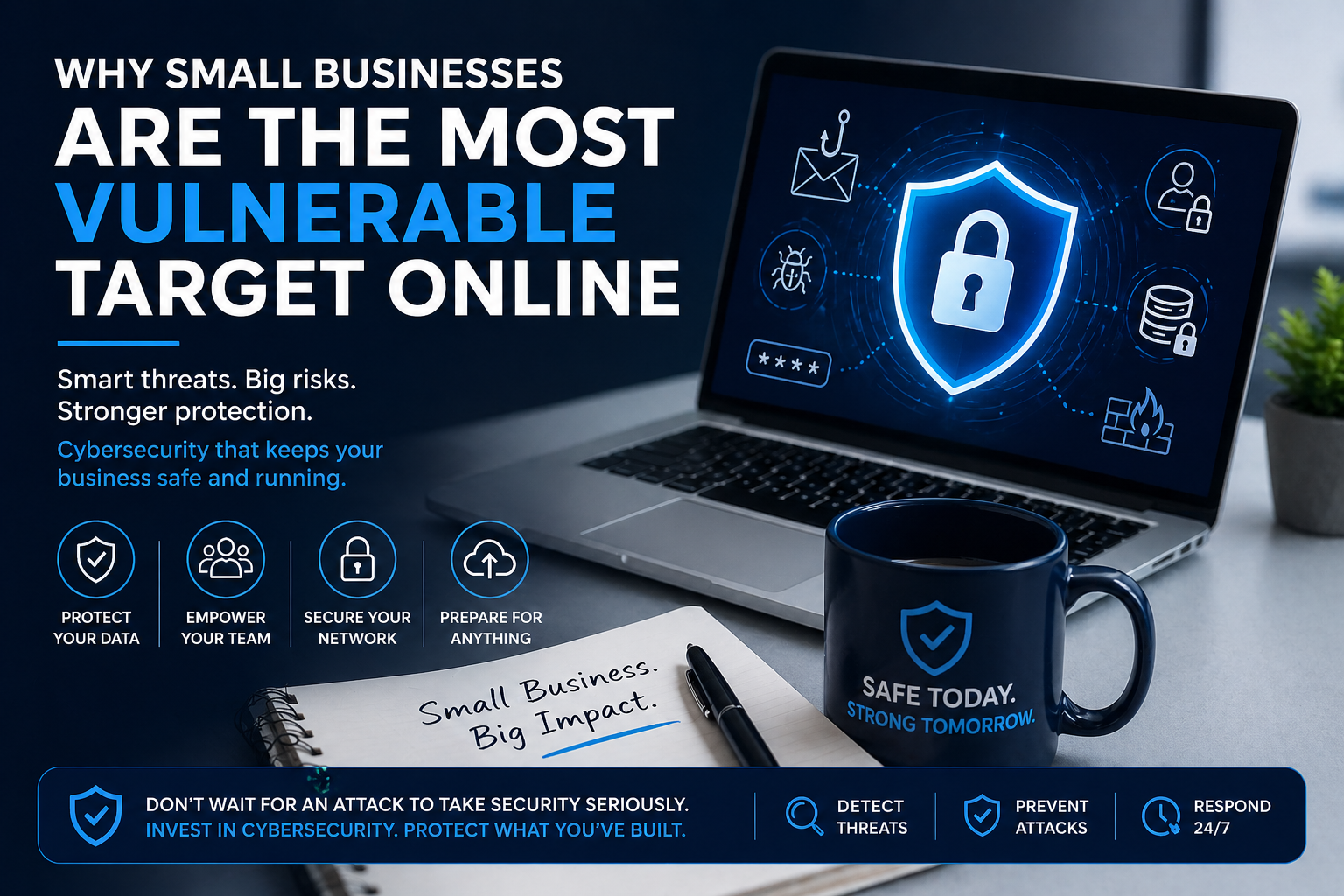
Why Small Businesses Are the Most Vulnerable Target Online
If you own or run a small business, there’s a reality you can’t afford to ignore: hackers don’t care how big your company is. In fact, they prefer small and mid-sized businesses as targets because most lack the cybersecurity defenses that larger enterprises take for granted. According to the FBI and numerous industry reports, small businesses are targeted in nearly half of all cyberattacks, and many never recover financially after a breach.
That’s where cybersecurity services for small business come in. You don’t need an enterprise-scale security team with a seven-figure budget to stay safe. What you need is a practical, layered approach to protecting your data, your people, and your revenue.
What Makes Small Businesses an Easy Target
Understanding what attackers look for is the first step toward building a defense that actually works.
Outdated Software and Unpatched Systems
Many small businesses run on software that hasn’t been updated in months — sometimes years. Every unpatched vulnerability is an unlocked door. Ransomware groups use automated tools to scan the internet for these open doors 24/7. If a system hasn’t been patched, it will eventually be found.
Weak or Reused Passwords
Using the same password across multiple accounts is like handing a master key to anyone who compromises one of those services. Password managers and multi-factor authentication eliminate this risk almost entirely, yet adoption among small businesses remains surprisingly low.
No Email Security
Phishing remains the number one entry point for cyberattacks targeted at small businesses. Without email filtering, a single clicked link can compromise your entire network, expose client data, and trigger regulatory fines.
Untrained Employees
Your team is either your strongest defense or your weakest point. Without regular security awareness training, even the best technology stack will fail because someone will inevitably click the wrong link or share credentials with the wrong person.
Essential Cybersecurity Services for Small Business — What You Actually Need
You don’t need every security product on the market. You need the right ones, configured correctly, monitored consistently. Here are the services that matter most for small and mid-sized businesses.
Endpoint Detection and Response (EDR)
Antivirus is not enough. Modern endpoint protection goes far beyond signature-based virus scanning. EDR solutions monitor behavior in real time, detect anomalies, isolate compromised machines, and roll back damage. For a small business, this is the difference between catching a threat early and waking up to an encrypted file server.
Managed Email Security
Email is how most attacks start. A managed email security solution scans inbound and outbound messages for phishing, malware, impersonation, and business email compromise (BEC). Combined with DMARC, SPF, and DKIM configuration, it dramatically reduces your exposure to email-based threats.
Network Monitoring and Managed Firewalls
A properly configured next-generation firewall (NGFW) with intrusion prevention, DNS filtering, and real-time monitoring acts as the gatekeeper for your network. The key word is managed — a firewall is only useful if someone is watching alerts and responding to threats. Most small businesses never look at their firewall logs until something has already gone wrong.
Backup and Business Continuity
If everything else fails, your backups are your lifeline. A 3-2-1 backup strategy — three copies of your data, stored on two different media, with one copy offsite — ensures you can recover from ransomware, hardware failure, or accidental deletion. Test your backups regularly. A backup you can’t restore is not a backup at all.
Security Awareness Training
Simulated phishing exercises and ongoing training transform your employees from targets into defenders. The goal isn’t to make security professionals out of office staff — it’s to make them confident enough to recognize and report suspicious activity before it becomes an incident.
Vulnerability Assessments and Patch Management
Regular vulnerability scanning identifies weak points before attackers do. Pair that with automated patch management, and you close the majority of exploitable gaps without relying on anyone remembering to click “update.”
How Much Does Cybersecurity for Small Business Actually Cost?
One of the biggest myths is that cybersecurity services for small business are prohibitively expensive. The reality: a basic managed security package for a 10–50 person company typically ranges from a few hundred to a few thousand dollars per month — depending on scope, compliance requirements, and the services included.
Compare that to the average cost of a data breach for a small business, which regularly exceeds $100,000 when you factor in downtime, recovery costs, legal fees, and reputational damage. That number doesn’t include potential regulatory fines, loss of client trust, or the cost of notifying affected customers.
Cybersecurity isn’t a cost center. It’s an insurance policy with a return on investment that you can measure in risk reduction, not just dollars spent.
How to Choose the Right Cybersecurity Provider
Not all providers are created equal. Here’s what to look for when evaluating cybersecurity services for small business:
- Industry experience — A provider that understands your sector will configure protections that match your actual risks, not generic templates.
- 24/7 monitoring and response — Attacks don’t follow business hours. Neither should your security team.
- Clear communication — If your provider can’t explain risks and actions in plain English, you’ll never know where you stand.
- Compliance knowledge — Whether you need HIPAA, CMMC, SOC 2, or general best practices, make sure your provider knows the requirements and can document compliance.
- Proactive, not reactive — The best security providers prevent incidents, not just respond to them.
Common Mistakes Small Businesses Make With Their Cybersecurity
Through years of working with small and mid-sized businesses, we see the same patterns over and over — and they’re almost entirely preventable.
Setting It and Forgetting It
Deploying a security tool and never reviewing it is like installing a lock on your front door and never checking if the key still works. Security configurations drift, threats evolve, and tools need ongoing tuning.
Assuming “We’re Too Small to Matter”
This is the single most common and most dangerous assumption attackers rely on. Automated scanning tools don’t discriminate by company size.
Relying on a Single IT Person
An overworked IT generalist trying to manage security alongside helpdesk tickets and server maintenance is not a security strategy. Even large enterprises outsource aspects of their security operations to specialist teams.
Take the Next Step — Secure Your Business Today
Don’t wait for an incident to take cybersecurity seriously. At Klouded, we specialize in providing cybersecurity services for small business that are practical, affordable, and built around your actual needs — not a one-size-fits-all checklist.
From endpoint protection and email security to compliance readiness and incident response, we help SMBs build real defenses without the enterprise price tag.
Ready to see how protected your business really is? Contact Klouded today for a free security assessment and get a clear, honest view of where you stand — and what needs to change before it’s too late.
Explore Klouded’s Cybersecurity Services →
