 Skip to content
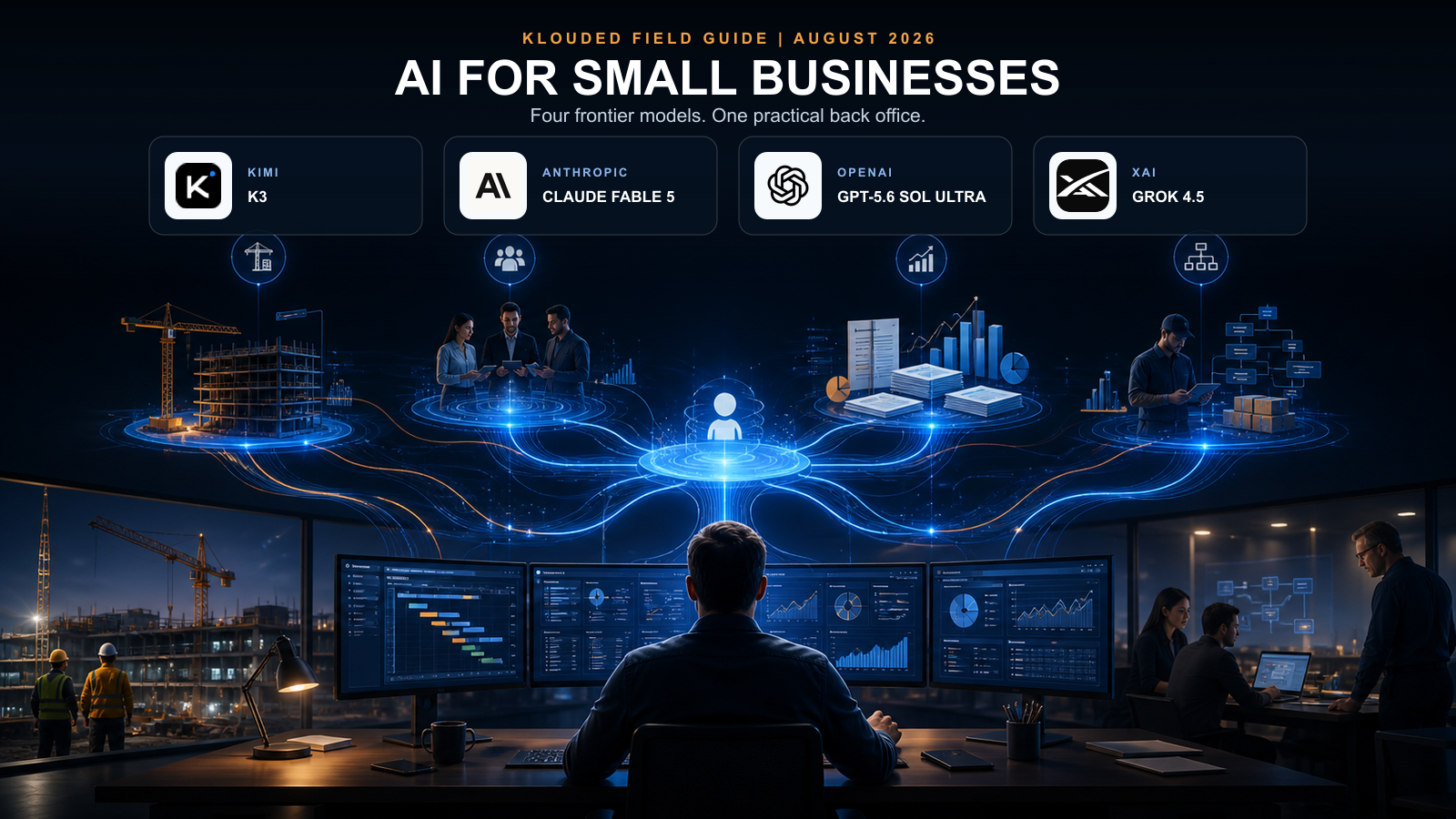
Short answer: The best AI for small businesses is not one model used for every job. OpenAI GPT-5.6 is the strongest general platform for a mixed portfolio of back-office agents. Grok 4.5 is an attractive value option for tool-using workflows based on its published API pricing. Kimi K3 stands out for long-context and cache-heavy work. Claude Fable 5 is a premium specialist for difficult, long-running coding, finance, and knowledge-work assignments. The strongest operating design routes each task to the right model and keeps people responsible for consequential decisions.
Small businesses do not need an AI science project. They need practical agents that can read approved records, update business systems, prepare work, surface exceptions, and hand important decisions to a person. Klouded has deployed AI agents in construction management, sales, and operations, and we are testing frontier models across realistic business workflows to understand where each one creates useful leverage.
This comparison reflects vendor-published product information available on August 4, 2026. Model names, features, availability, safeguards, and pricing can change. Validate current terms before selecting a production platform.
AI for Small Businesses: What Should Owners Compare?
A model comparison matters only when it is connected to a business outcome. A construction company may need an agent to organize project correspondence and prepare status updates. A sales team may need lead intake, CRM updates, and follow-up drafts. An operations team may need exception monitoring across orders, inventory, field work, and customer requests.
For those workflows, a useful small-business AI evaluation should measure:
- Accuracy: Does the answer match trusted business records?
- Tool use: Can the model reliably call approved applications and APIs?
- Instruction following: Does it stay within the assigned workflow and permissions?
- Context capacity: Can it work with the documents, history, and operating procedures required for the task?
- Human review effort: How much correction is needed before the result can be used?
- Total cost: What do tokens, tools, retries, monitoring, integrations, and supervision cost together?
- Recoverability: Does the agent recognize a failed action, stop safely, and provide a useful handoff?
A low token price does not automatically mean a low-cost deployment. A model that needs repeated prompts or creates avoidable rework can be more expensive than a higher-priced model that completes the task correctly. The right comparison uses your workflow, data, risk, and definition of success.
Kimi K3 vs Claude Fable 5 vs GPT-5.6 Sol Ultra vs Grok 4.5
| Model | Best small-business fit | Published API price per 1M tokens | Primary consideration |
|---|---|---|---|
| Kimi K3 | Large document sets, long context, coding, structured output, and cache-heavy workflows | $3 input, $15 output; $0.30 cache-hit input | Strong boundaries and workflow testing are still required before tool access is expanded. |
| Claude Fable 5 | Premium long-running agents, complex coding, finance, vision, and document-heavy knowledge work | $10 input, $50 output; cached input discount available | The highest list price in this comparison needs to be justified by lower rework or higher task value. |
| GPT-5.6 Sol with ultra | Complex mixed workflows, multi-agent coordination, coding, documents, analysis, and business tools | Sol: $5 input, $30 output | Ultra is a high-capability multi-agent setting, not a separate base model, and it uses more compute and tokens. |
| Grok 4.5 | Cost-conscious tool-using agents, coding, research, and workflows that benefit from web or X search | $2 input, $6 output | External search should be restricted to workflows where current public information is appropriate and sources can be verified. |
These prices and capabilities are published by the vendors. They are useful starting points, not independent proof that a model will perform best with your data. Enterprise agreements, caching, regional availability, safety controls, tool charges, and usage patterns can change the final economics.
Kimi K3: Best for Long Context and Repeated Business Knowledge
Kimi K3 provides a published 1,048,576-token context window and supports tool calls, JSON mode, structured output, and automatic caching. Those capabilities can be useful when an AI agent must work through a large project record, a long operating manual, a sizeable codebase, or a repeated set of company documents.
For a small business, the cache-hit input price is particularly relevant when the same procedures, product catalog, policies, or project history are reused across many requests. Kimi K3 is a strong candidate for document-intensive agents, but it should still be evaluated for accuracy, permissions, and recovery behavior before it is allowed to change business records.
Claude Fable 5: Best Premium Specialist for Difficult Work
Anthropic positions Claude Fable 5 for ambitious, long-running agents and difficult professional work. Its intended strengths include coding, vision, finance, and document-heavy analysis. That makes it relevant for jobs such as reviewing a complicated project package, analyzing a financial workbook with supporting documents, or working through a multi-stage software assignment.
Fable 5 has the highest published standard price among these four options. A small business should reserve it for tasks where the additional capability reduces meaningful risk, review time, or rework. Anthropic also states that Fable 5 requests require 30-day data retention for safety monitoring, so privacy, contractual, and data-classification requirements should be reviewed before sensitive records are used.
GPT-5.6 Sol Ultra: Best General Platform for Mixed Agent Workflows
OpenAI’s GPT-5.6 family includes Sol, Terra, and Luna. That range gives a small business a practical way to route routine work to lower-cost models and escalate difficult tasks to Sol. GPT-5.6 Sol also has a published 1.05-million-token context window and is designed for advanced reasoning, coding, professional work, and tools.
The word ultra needs clarification. It is not a fourth GPT-5.6 model. OpenAI describes ultra as its highest-capability setting, which coordinates multiple agents by default in supported products and uses more tokens. That can help with complex research, coding, or multi-step analysis, but it is unnecessary for routine classification, extraction, and drafting.
Klouded’s editorial view is that the GPT-5.6 family is the strongest general starting platform for a business with varied workflows. The reason is not that Sol should handle every job. It is that a well-designed router can use Luna or Terra for routine volume, Sol for harder tasks, and ultra only when multi-agent depth creates enough value to justify the cost.
Grok 4.5: Best Value-Priced Option for Tool-Using Agents
xAI describes Grok 4.5 as a model for coding, agentic tasks, and knowledge work. Its documented tools include function calling, web search, X search, and code execution, with low, medium, and high reasoning settings. Among the four specific flagship options in this comparison, Grok 4.5 has the lowest published standard input and output price.
That combination makes Grok 4.5 worth testing for cost-sensitive agents that need to call business tools or retrieve current public information. Search access must be controlled. A back-office agent should not mix unverified public posts into customer, finance, project, or compliance records without source checks and explicit policy.
How Small Businesses Can Use AI Agents in the Back Office
An AI agent is more than a chatbot. A useful back-office agent combines a model with instructions, approved data, tools, permissions, memory, monitoring, and human approval rules. The model interprets the task. The surrounding system determines what information it can see, what actions it can take, and when it must stop for a person.
A practical small-business agent architecture includes:
- Intake: Receive a request from email, phone, CRM, ERP, form, document queue, or an employee.
- Trusted context: Retrieve the approved customer, project, product, policy, or transaction records needed for the task.
- Model routing: Send routine work to a lower-cost model and escalate difficult or high-value work to a stronger model.
- Tool execution: Use narrowly scoped permissions to draft, search, calculate, create a task, update a record, or prepare a transaction.
- Policy check: Validate required fields, confidence, source support, business rules, and permission boundaries.
- Human approval: Require a person before money moves, customer commitments change, production systems are modified, or sensitive decisions are finalized.
- Monitoring: Record the request, evidence, model version, output, tool actions, approval, and final result.
This structure turns AI back-office automation into a managed business process. It also makes it easier to replace a model later without rebuilding every integration.
AI Agents for Construction Management
Construction management creates a constant flow of emails, project updates, photos, meeting notes, requests, schedules, vendor records, and financial information. An AI agent can help organize that work without pretending to be the project manager.
Useful construction management AI agent workflows can include:
- Classifying incoming project correspondence and routing it to the right job or owner.
- Preparing daily or weekly project summaries from approved source records.
- Extracting dates, parties, commitments, and open items from meeting notes and documents.
- Drafting follow-up tasks for RFIs, submittals, change requests, purchasing, or field coordination.
- Comparing reported status with schedules, budgets, and job records to surface exceptions.
- Helping employees find the current procedure, specification, or project context.
A human project owner should approve schedule commitments, scope changes, contract notices, safety decisions, cost impacts, and customer communications. The agent prepares and monitors the work; accountable professionals make the decision.
AI Agents for Sales and CRM Operations
Sales agents can reduce the administrative gap between a customer conversation and the next action. They can work across approved channels such as forms, email, phone transcripts, calendars, and CRM systems.
- Capture and classify inbound leads.
- Create or enrich CRM records using approved data.
- Route opportunities by territory, product, urgency, or account owner.
- Summarize calls and prepare personalized follow-up drafts.
- Identify missing information before a quote or discovery call.
- Monitor stalled opportunities and recommend the next action.
- Prepare management summaries from pipeline activity.
People should remain responsible for pricing exceptions, contract terms, sensitive customer issues, and promises about delivery. AI can improve speed and CRM consistency without becoming an unsupervised salesperson.
AI Agents for Operations and Administration
Operations agents are useful where teams repeatedly gather information from several systems, apply known rules, and prepare a next step. Examples include:
- Monitoring order, inventory, field-service, or support queues for exceptions.
- Matching invoices, purchase orders, receipts, and approval records for review.
- Preparing work orders, task handoffs, and internal notifications.
- Answering employee questions from controlled procedures and knowledge bases.
- Summarizing recurring issues for managers and identifying process bottlenecks.
- Drafting customer or vendor communications from verified transaction data.
- Coordinating activity across CRM, ERP, email, project, and service platforms.
The highest-value starting point is usually a repetitive process with clear inputs, frequent volume, measurable delay, and a defined human owner. Avoid beginning with the broad instruction to “run operations.” Give the agent one workflow, clear permissions, and an objective success test.
AI Agents for Finance and Back-Office Reporting
AI can help finance and administrative teams extract information, compare records, explain variances, prepare management summaries, and identify questions for review. It can also help organize documents that arrive through email, shared folders, and business applications.
AI should not independently approve payments, post material accounting entries, change payroll, file taxes, extend credit, or make investment decisions. Financial agents need source traceability, role-based access, separation of duties, and human approval. A persuasive explanation is not proof that the underlying number is correct.
How Klouded Deploys Small-Business AI Agents
Klouded has deployed AI agents in construction management, sales, and operations. The specific tools and controls vary by client, but the implementation discipline is consistent: start with a real workflow, connect only approved systems, limit permissions, define human approval points, test exceptions, and monitor what the agent actually does.
Our work focuses on the complete operating system around the model:
- Workflow discovery and process mapping.
- Model and platform evaluation using the client’s own task criteria.
- Connections to approved CRM, ERP, project, email, phone, document, and operations tools.
- Role-based permissions and data boundaries.
- Human review and escalation rules.
- Testing for normal cases, exceptions, failed tools, and ambiguous requests.
- Monitoring, audit records, cost controls, and continuous improvement.
That is the difference between buying access to a model and deploying an AI agent that supports the back office. Learn more about Klouded AI automation services or contact Klouded to discuss a workflow in construction management, sales, finance, or operations.
Why Human and AI Collaboration Produces Better Results
AI brings speed, scale, and the ability to process more information than a person can review manually. People bring authority, relationships, practical context, ethics, and responsibility for the outcome. Small-business AI agents work best when those strengths are deliberately combined.
Human review should be strongest when a decision affects money, employment, safety, contracts, customer promises, cybersecurity, private data, or production systems. Low-risk and reversible tasks can be automated more aggressively. High-impact or difficult-to-reverse actions should require stronger evidence and explicit approval.
This approach does not weaken automation. It gives the agent a reliable operating boundary. Employees spend less time collecting and copying information while retaining control over decisions that require judgment or accountability.
A Practical 90-Day AI Adoption Plan for Small Businesses
Days 1-30: Select and Baseline One Workflow
- Choose one repetitive, measurable process with a clear owner.
- Document the current volume, cycle time, error rate, backlog, and labor effort.
- Identify the systems, data classifications, permissions, and approvals involved.
- Create a small test set that includes normal cases and important exceptions.
Days 31-60: Build a Controlled Pilot
- Compare two or more models on the same realistic tasks.
- Connect read-only tools first, then add narrowly scoped write actions.
- Require human approval while the team measures accuracy and exceptions.
- Track model cost, tool failures, review time, rework, and user feedback.
Days 61-90: Harden and Expand Carefully
- Improve instructions, data retrieval, validation, and failure handling.
- Automate low-risk steps that have demonstrated consistent performance.
- Keep approval gates for consequential actions.
- Document ownership, monitoring, rollback, and model-change procedures.
- Expand only when the pilot creates measurable business value.
Final Verdict: Which Model Is Best for Small-Business AI Agents?
Best general platform: GPT-5.6. Its model family and tool ecosystem make it a practical default for a varied portfolio of small-business agents. Use Sol and ultra selectively rather than paying flagship rates for routine work.
Best value-priced flagship option: Grok 4.5. Its published standard price and documented tool capabilities make it attractive for cost-conscious agent pilots. Validate output quality, search behavior, and workflow controls with your own data.
Best long-context and cache-focused option: Kimi K3. Its large context window, structured outputs, tool support, and low cache-hit input price are compelling for repeated work over large business knowledge sets.
Best premium specialist: Claude Fable 5. It is worth testing for difficult, long-running coding, finance, vision, and document-heavy work where better performance can justify higher cost.
The best AI for small businesses is a controlled portfolio: use the least expensive model that meets the quality requirement, escalate difficult work, and keep people accountable for the result.
Frequently Asked Questions About AI for Small Businesses
What is the best AI for small businesses?
GPT-5.6 is the strongest general starting platform in Klouded’s editorial assessment, but there is no universal winner. Grok 4.5 may fit cost-sensitive tool use, Kimi K3 may fit long-context and cache-heavy work, and Claude Fable 5 may fit high-value specialist tasks. Test the models on the exact workflow you plan to automate.
How can small businesses use AI agents?
Small businesses can use AI agents for lead intake, CRM updates, call and email summaries, project administration, document processing, purchasing support, order exceptions, reporting, knowledge retrieval, and task routing. Start with one measurable workflow and limited permissions.
Can AI automate back-office work?
Yes. AI can automate or accelerate structured back-office steps such as classification, extraction, matching, summarization, drafting, routing, and record preparation. Consequential actions involving money, contracts, people, safety, customer commitments, or system access should keep human approval.
Which AI model is cheapest for a small business?
Among Kimi K3, Claude Fable 5, GPT-5.6 Sol, and Grok 4.5, Grok 4.5 has the lowest published standard input and output price. Kimi K3 has a lower published cache-hit input price. Real cost depends on output length, caching, retries, tools, integration, and human review.
Do AI agents replace back-office employees?
AI agents are most useful as operational support. They can handle repetitive preparation and monitoring while employees manage exceptions, relationships, approvals, and decisions. The goal is to increase capacity and consistency, not remove accountability.
How does Klouded help companies deploy AI agents?
Klouded maps the workflow, evaluates models, connects approved tools, limits permissions, designs human approvals, tests exceptions, and monitors results. We have deployed AI agents in construction management, sales, and operations and can help a business identify a practical first use case.
Build a Practical AI Back Office With Klouded
Klouded helps small and mid-sized businesses turn AI models into controlled agents that support real operating work. Bring us a repetitive workflow, a growing backlog, or a process that depends on too much manual follow-up. We will help you evaluate the opportunity, select the right model, connect the right tools, and keep people in control.
Official Research Sources
- Kimi: Kimi K3 pricing and model capabilities
- Anthropic: Claude Fable 5
- OpenAI: Introducing GPT-5.6
- OpenAI developer documentation: GPT-5.6 Sol
- xAI developer documentation: Grok 4.5
- NIST: AI Risk Management Framework
- U.S. Small Business Administration Office of Advocacy: AI in Business – Small Firms Closing In
Kimi, Anthropic, Claude, OpenAI, ChatGPT, GPT, xAI, and Grok names and marks belong to their respective owners. Their inclusion is for editorial comparison and does not imply endorsement, certification, or partnership. Klouded’s model recommendations are an editorial assessment, not a vendor-sponsored benchmark. Results depend on the workflow, data, configuration, controls, and review process.
